
Introduction: Software Engineering Has Quietly Changed Shape
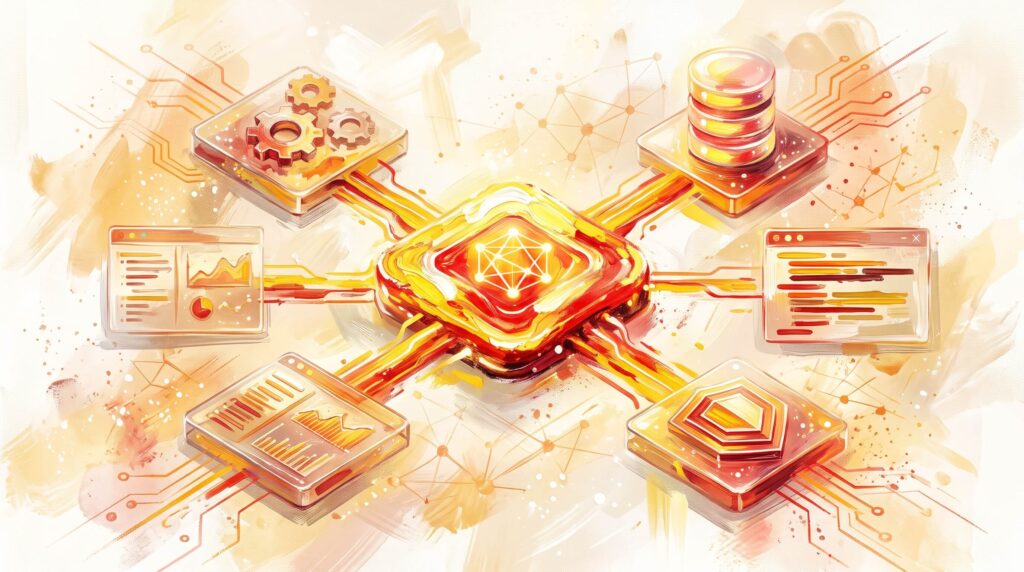
A few years ago, “building with AI” meant calling an API and printing the response. Today, the most valuable engineers are building systems: agents that plan and act, retrieval layers that feed models the right information, evaluation pipelines that catch regressions, and infrastructure that keeps all of it fast, safe, and affordable.
This guide walks through the trends shaping software engineering and computer science right now, explains why each one matters, and gives you concrete steps to build skills that last longer than any single framework or model release.
Table of Contents
- From prompt engineering to context engineering
- Agentic AI: moving from chatbots to systems that act
- MCP and the standardization of tool access
- Evals: the new unit tests
- AI observability and reliability engineering
- AI-assisted software development
- Small models, on-device AI, and AI-native operating systems
- Security in the age of agents
- Foundations that still win: systems, data, and memory-safe languages
- A practical learning roadmap
- Frequently asked questions
1. From Prompt Engineering to Context Engineering
Prompt engineering taught us that wording matters. Context engineering is the mature version of that idea: deciding what information a model sees, in what order, in what format, and at what time.
A production AI feature rarely fails because the prompt was phrased badly. It fails because the model was given too much irrelevant text, too little relevant text, stale data, or conflicting instructions. Good context engineering includes:
- Retrieval design: chunking strategy, hybrid search (keyword plus vector), reranking, and metadata filtering.
- Memory management: deciding what to persist between sessions, what to summarize, and what to forget.
- Context budgeting: treating the context window like a scarce resource, since every token costs money and attention.
- Structured inputs and outputs: schemas, typed tool results, and validation so downstream code can trust what the model returns.
Takeaway: If you can explain why a specific piece of information is in the model’s context, and what breaks if it’s removed, you are doing context engineering.
2. Agentic AI: Moving From Chatbots to Systems That Act
An AI agent is a system where a model decides which actions to take, uses tools to take them, observes the results, and continues until a goal is met. This loop is simple to describe and hard to make dependable.
Common agent patterns worth knowing:
- Single-agent with tools: one model, a set of functions, a loop. Start here; it solves more problems than people expect.
- Planner and executor: one step drafts a plan, another carries out each step, which improves control and debuggability.
- Multi-agent collaboration: specialized agents (researcher, coder, reviewer) coordinated by an orchestrator. Powerful, but adds latency, cost, and failure modes.
- Human-in-the-loop checkpoints: approvals before irreversible actions such as sending money, deleting data, or deploying code.
Engineering reality check: Reliability compounds. If each step in a ten-step workflow succeeds 95% of the time, the whole run succeeds far less often than 95%. The best agent builders constrain the problem, shorten the loops, validate every step, and add retries and fallbacks deliberately.
3. MCP and the Standardization of Tool Access
One of the most important infrastructure trends is the rise of open protocols for connecting models to tools and data. The Model Context Protocol (MCP) is an open standard that lets AI applications connect to external systems (files, databases, SaaS tools, internal APIs) through a consistent interface instead of one-off integrations.
Why this matters for engineers:
- Less glue code: write a tool server once and reuse it across compatible clients.
- Clear boundaries: capabilities, permissions, and data access are explicit.
- Ecosystem leverage: a growing catalog of ready-made servers means you spend time on your product, not plumbing.
If you are designing an internal platform, consider exposing your company’s key systems through well-scoped, well-documented tool interfaces. Treat them like public APIs: version them, test them, and apply least-privilege access.
4. Evals: The New Unit Tests
Traditional software is deterministic; AI features are probabilistic. That means “it worked on my laptop” is meaningless without evaluations.
A healthy eval practice has layers:
- Golden datasets: curated inputs with expected behaviors, built from real user traffic (anonymized) and known edge cases.
- Automated graders: code-based checks for format and correctness, plus model-based graders for subjective quality, calibrated against human review.
- Regression gates in CI: every prompt, model, or retrieval change runs the suite before shipping.
- Online evaluation: monitoring real-world quality signals such as task completion, user corrections, and escalation rates.
Pro tip: Start small. Twenty well-chosen test cases that reflect real failures are more valuable than a thousand synthetic ones nobody trusts.
5. AI Observability and Reliability Engineering
You cannot fix what you cannot see. Production AI systems need observability beyond logs and CPU graphs:
- Traces that capture each model call, tool call, retrieved document, and intermediate decision in an agent run.
- Cost and latency metrics per feature, per user segment, and per model.
- Quality metrics tied to business outcomes, not just “the response was generated.”
- Guardrail telemetry: how often validations fail, how often outputs are blocked, and why.
On the reliability side, borrow from classic SRE: define SLOs, use timeouts and circuit breakers, cache aggressively where outputs are repeatable, and design graceful degradation (for example, falling back to a smaller model or a non-AI path when a provider is slow).
6. AI-Assisted Software Development
Coding assistants and agentic coding tools have moved from autocomplete to multi-file changes, test generation, refactoring, and code review. The engineers getting the most value share a few habits:
- They specify clearly. Good tickets, clear acceptance criteria, and architectural constraints produce better generated code.
- They review rigorously. Generated code is still code you own. Read it, run it, and test it.
- They keep strong fundamentals. Debugging, reading unfamiliar code, and reasoning about complexity become more valuable when code is cheap to produce.
- They invest in feedback loops. Fast tests, linters, type checkers, and CI let both humans and agents verify work quickly.
The skill shift is from typing code to directing, verifying, and integrating it.
7. Small Models, On-Device AI, and AI-Native Operating Systems
Not every task needs the largest model. A major trend is the rise of smaller, specialized, and on-device models that offer lower latency, lower cost, and better privacy.
This connects directly to the evolution of operating systems. Modern OS platforms are increasingly integrating AI capabilities at the system level: on-device inference runtimes, hardware acceleration through NPUs and GPUs, system-wide assistants, and permissioned APIs that let apps use local models and context safely. For developers, that means:
- Learning how to quantize, distill, and benchmark models for constrained hardware.
- Designing hybrid architectures that route simple tasks locally and hard tasks to the cloud.
- Respecting OS-level permission and privacy models when apps access user data for AI features.
- Understanding operating-system fundamentals (scheduling, memory, I/O, sandboxing) because AI workloads stress all of them.
8. Security in the Age of Agents
When a model can call tools, security stops being optional. Key risks to design against:
- Prompt injection: malicious instructions hidden in web pages, emails, or documents that an agent reads. Treat all retrieved content as untrusted data, never as instructions.
- Excessive permissions: agents should have the minimum access needed, with scoped credentials and short-lived tokens.
- Data leakage: control what sensitive information enters prompts, logs, and third-party services.
- Unsafe actions: require confirmation for destructive or irreversible operations and keep audit logs.
- Supply chain risk: vet third-party tools, plugins, and dependencies the same way you vet any other code.
Security reviews for AI systems should include threat modeling of the whole loop: inputs, retrieval, tool use, and outputs.
9. Foundations That Still Win
Trends change quickly; fundamentals compound. The engineers who thrive through every wave tend to be strong in:
- Distributed systems: queues, idempotency, consistency, backpressure, and failure handling.
- Data engineering: clean pipelines, versioned datasets, and good schemas make every AI feature better.
- Performance engineering: profiling, caching, batching, and understanding where latency really comes from.
- Memory-safe and systems languages: Rust, Go, and modern C++ practices continue to matter for infrastructure, runtimes, and inference engines, while Python and TypeScript dominate application-layer AI work.
- Clear communication: writing design docs, explaining tradeoffs, and documenting decisions.
10. A Practical Learning Roadmap
Month 1: Build the basics. Call a model API, add structured outputs, and build a small retrieval-augmented app over your own documents.
Month 2: Add reliability. Write an eval set, add tracing, and measure cost and latency. Improve your app using data, not intuition.
Month 3: Go agentic. Build an agent with two or three tools, add human approval for risky actions, and test failure paths.
Month 4: Ship it. Deploy, monitor, handle security reviews, and write a case study explaining your architecture and tradeoffs. Publishing this work is one of the best career signals you can create.
Frequently Asked Questions
What is AI engineering? AI engineering is the discipline of building reliable, scalable, and safe software systems that use machine learning models, especially large language models, as components. It blends software engineering, data engineering, and applied ML.
Is prompt engineering still relevant? Yes, but it is now one part of the larger practice of context engineering, which also covers retrieval, memory, tool design, and evaluation.
Do I need a machine learning PhD to work in AI engineering? No. Many AI engineering roles focus on integrating and operating models rather than training them from scratch. Strong software engineering fundamentals are the main prerequisite.
What is the difference between an AI agent and a chatbot? A chatbot mostly responds to messages. An agent can plan, call tools, take actions, observe results, and iterate toward a goal.
How do I make AI features reliable? Use evals, structured outputs, validation, observability, retries and fallbacks, and human approval for high-risk actions.
Conclusion
The center of gravity in software engineering is moving from writing every line of code to designing systems where models, tools, data, and people work together. The winning approach is not chasing every new release. It is mastering a durable set of skills: context design, evaluation, observability, security, and solid computer science fundamentals.
Pick one project from the roadmap above, build it end to end, and measure it honestly. That single habit will teach you more than any trend report, including this one.